Last updated: September 2026
Top Outside Catering Services in Kenya: Prices, Menus & Booking Guide
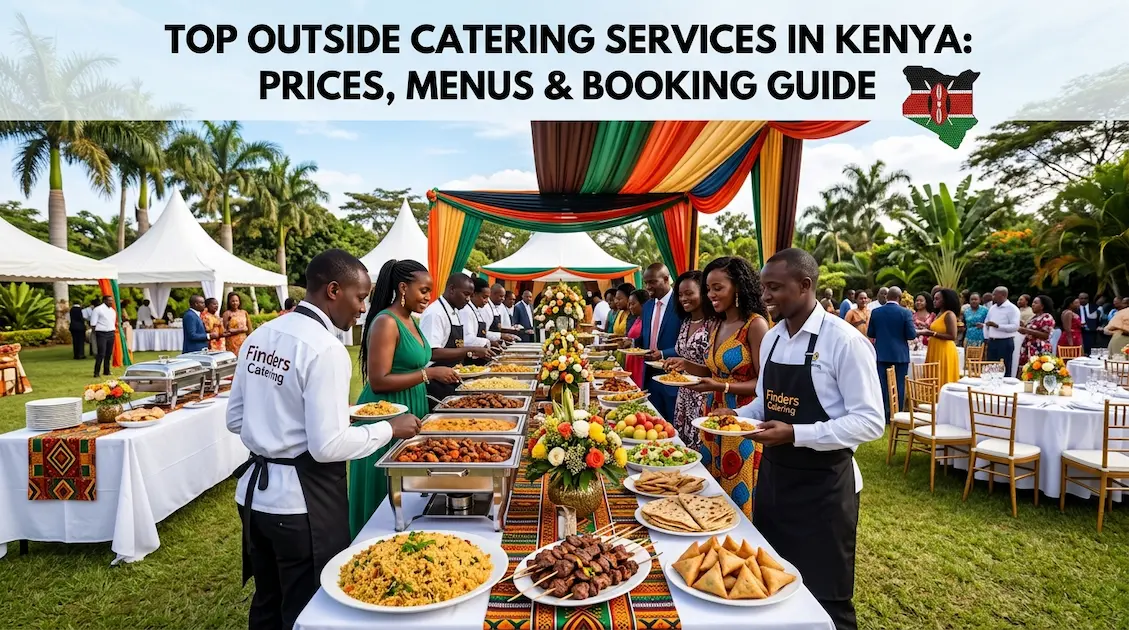
Outside catering services in Kenya provide food preparation, delivery, setup and, depending on the package, serving and cleanup at a venue chosen by the client. They are commonly used for weddings, corporate functions, birthdays, family gatherings, church events, private parties and outdoor celebrations.
Unlike a venue's in-house catering service, outside catering allows the client to choose a separate caterer and bring the catering operation to the event location. The caterer may prepare food off-site, cook at the venue or combine both approaches depending on the menu and facilities available.
Outside catering can be particularly useful in Nairobi and the surrounding metropolitan area, where events are held in hotels, gardens, private compounds, offices, churches, conference facilities and other venues that may not provide a complete catering service.
It is also widely relevant to events in Kiambu, Ruiru, Thika, Kajiado, Machakos, Mombasa, Kilifi, Kisumu and Nakuru, where clients may need catering brought to venues outside traditional hotels and restaurants.
However, choosing a caterer involves more than finding the lowest advertised price per person. The menu, guest count, service style, staffing, transport, preparation facilities, crockery, cutlery, drinks, equipment, setup, cleanup and payment terms can all affect the final cost.
This guide explains outside catering services in Kenya, including indicative 2026 prices, popular Kenyan menus, wedding and corporate catering, food quantities, catering packages, chafing dishes, mobile kitchens, event logistics, food hygiene, contracts and practical booking tips.
Quick Answer: What Does Outside Catering Cost in Kenya?
Outside catering prices in Kenya can range from roughly KES 500 to KES 5,000+ per guest, depending on the menu, type of event, guest count, location, staffing, equipment and level of service. Simple functions tend to cost less, while premium weddings and corporate or executive events can cost considerably more.
- Basic church, community or simple gathering: about KES 500–1,000 per guest.
- Standard private parties and weddings: about KES 1,200–2,500 per guest.
- Higher-end weddings and special functions: about KES 2,000–3,500+ per guest.
- Corporate and executive events: about KES 3,000–5,000+ per guest.
These are indicative planning ranges for 2026, not fixed national prices. Individual caterers may charge more or less depending on the food, service and logistics included in the quotation.
For example, 100 guests at KES 1,500 per person would produce a food-and-service estimate of KES 150,000. The final amount could be higher if transport, equipment, drinks, additional staffing, service charges or applicable taxes are excluded.
Table of Contents
What Is Outside Catering?
Outside catering is a food and event service provided at a location selected by the client rather than through the venue's own catering operation. Depending on the provider, the caterer may prepare food elsewhere, transport it to the venue, cook at the venue or use a combination of these services.
A typical outside catering package may include menu planning, food preparation, transportation, buffet setup, serving staff, crockery, cutlery, food warmers, drinks, cleanup and other event-day requirements.
This makes outside catering suitable for venues that do not have a full commercial kitchen or for clients who want to select their own food provider.
The exact meaning of a "full catering service" varies between providers. Before booking, ask the caterer to specify every service and item included in the quotation.
Outside Catering Prices in Kenya
Outside catering prices in Kenya depend mainly on the type of food, number of guests, location, service style, equipment and staffing. There is no single national price that applies to every caterer or event.
As a general planning guide for 2026, you may encounter the following indicative ranges:
- KES 500–1,000 per person: basic meals for simple gatherings, church functions or community events.
- KES 1,200–2,500 per person: standard private parties and many wedding catering arrangements.
- KES 2,000–3,500+ per person: more elaborate weddings and special functions.
- KES 3,000–5,000+ per person: some corporate and executive catering arrangements.
These figures should be treated as indicative planning ranges, not fixed national prices. Caterers may price differently depending on location, menu, guest count, equipment and service requirements.
For example, a quotation for an event in Nairobi may differ from one for a function outside the city because of transport and logistics. A caterer travelling to Thika, Machakos, Mombasa or another location may also factor travel time and fuel into the price.
Always request a written quotation showing the price per guest, total estimated cost, services included and any charges billed separately.
What Determines the Cost Per Guest?
The cost per guest is determined by more than the food itself. Two caterers can quote different prices for what appears to be the same event because their packages include different levels of service and equipment.
Menu Complexity
A simple rice, stew and vegetable meal will normally have different costs from a menu involving several meats, starters, desserts, live cooking stations and specialised dishes.
Number of Guests
Larger events require more food, equipment, serving staff and logistics. Some caterers may offer different pricing at higher guest volumes, while others may have minimum order requirements.
Serving Style
Buffet service, plated meals, food stations and simple food delivery require different levels of staffing and equipment.
Location
Transport distance, venue accessibility, parking, loading arrangements and the availability of food preparation space can affect the quotation.
Equipment
Catering equipment may include chafing dishes, serving tables, cooking equipment, crockery, cutlery, glassware and other items.
Staffing
A full-service event may require chefs, servers, supervisors, cleaners and other staff.
Additional Charges
Ask about transport or fuel, equipment hire, corkage, additional staff, special dietary meals, extra guests, overtime, breakage deposits, service charges and applicable taxes.
If a caterer mentions a service charge, ask whether it is already included in the quoted price. A 10–15% service charge, where applicable, should not be assumed to be universal.
If VAT applies to the service, ask whether the quoted amount is VAT-inclusive.
Wedding Outside Catering
Wedding outside catering requires coordination between the menu, guest numbers, venue, service staff, equipment and wedding programme. This is why a wedding catering quotation should contain more than a simple price per plate.
A wedding caterer may need to coordinate food preparation, transportation, buffet setup, serving staff, equipment and cleanup while working according to a strict event programme.
A garden wedding in Karen may have very different requirements from a reception at a hotel in Westlands. An outdoor venue may require additional planning for food preparation, serving areas, electricity, weather and guest movement.
Your quotation should clearly state whether it includes:
- Guest count
- Welcome drinks
- Main meal
- Side dishes
- Dessert
- Tea and coffee
- Children's meals where required
- Special dietary meals
- Serving staff
- Crockery and cutlery
- Buffet tables and serving equipment
- Transport
- Cleanup
- Applicable taxes and service charges
For a broader guide to choosing professionals, see our article on caterers in Kenya.
Before booking wedding outside catering, ask about the minimum number of guests, how changes to the guest count are handled, drinks, crockery, cutlery, transport, servers, buffet tables, cleanup, tasting arrangements and what happens if the date or venue changes.
Corporate Event Catering
Corporate catering is designed around the schedule and format of a business event. Conferences, seminars, staff meetings, training sessions, product launches, workshops, client meetings, business breakfasts, executive dinners and end-of-year functions can all require different catering arrangements.
Corporate events often require careful timing because food may need to be served during a short scheduled break.
Depending on the event, you may need breakfast, tea and coffee, snacks, lunch boxes, buffet lunch, food party platters or a formal meal.
When requesting a quotation, provide the caterer with the event schedule so that they can plan delivery, setup and service appropriately.
Businesses should also consider their invoicing and tax documentation requirements. The Kenya Revenue Authority provides information about electronic tax invoicing through eTIMS.
Birthday and Private Event Catering
Private event catering can be arranged for both small and large gatherings. You do not need to be organising a large wedding to use an outside caterer.
Birthday parties, anniversaries, graduations, family reunions, baby showers and private gatherings can all benefit from professional catering.
Popular Kenyan dishes may include pilau, rice, chapati, beef stew, chicken, goat meat, nyama choma, vegetables, ugali, salads, samosas, mandazi, fruit and cakes or other desserts.
For a smaller event of around 20–40 guests, ask whether the caterer has a minimum order, minimum catering charge or delivery fee.
You may only need food preparation and delivery, or you may prefer a complete service that includes setup and serving staff.
What Is Included in a Catering Package?
A catering package may include food only, or it may combine food, equipment, staffing, transportation, setup and cleanup. Packages differ significantly between providers.
Before comparing two quotations, make sure you are comparing similar services.
One caterer might quote KES 1,500 per person for food only, while another might quote KES 2,000 per person including servers, crockery, buffet equipment and transportation. The second quotation may therefore provide better overall value even though its headline price is higher.
When comparing packages, check whether the following are included:
- Food and menu items
- Drinks
- Serving staff
- Crockery and cutlery
- Buffet equipment
- Tables and serving equipment
- Transport
- Setup
- Cleanup
- Taxes and service charges
How Much Food Do You Need?
The amount of food required for an event depends on guest numbers, the menu, portion sizes, serving style and the duration of the event. There is no single quantity formula that works for every dish.
A basic planning concept is:
Expected guests × planned portion per guest = estimated food requirement
Meat, rice, vegetables, snacks, desserts and drinks all have different serving requirements. Your caterer should help determine quantities based on the menu, guest profile, serving style and duration of the event.
For some traditional or open-access functions, a contingency of around 10–15% may be considered, but this should not be treated as a universal rule. The appropriate amount depends on the event and menu.
Drinks should also be planned separately. Depending on the event, these may include water, soft drinks, juice, tea, coffee and welcome drinks.
Popular Kenyan Catering Menus
Popular Kenyan catering menus vary according to region, occasion, budget and guest preferences. A good event menu should balance the type of occasion with the number of guests, service style and available budget.
Weddings, ruracio, koito and other traditional family gatherings may include dishes such as pilau, chapati, beef, chicken, goat meat, vegetables, rice and other traditional accompaniments.
Corporate events may favour lighter and more structured menus, particularly when meals need to fit around meetings or presentations.
Caterers may also provide vegetarian, halal, gluten-free, allergy-conscious and children's meal options where requested.
Live cooking can be another option. Depending on the caterer, this could include nyama choma, chapati, grilled meats, pasta or freshly prepared snacks.
Buffet service using chafing dishes can be practical for larger events because it allows guests to serve themselves while helping keep prepared food warm.
Chafing Dishes and Mobile Kitchens
Chafing dishes are commonly useful for buffet-style outside catering because they help keep prepared food warm during service. However, the caterer should explain what equipment is included in the package.
Before the event, confirm:
- How many chafing dishes are provided
- Their approximate capacity
- What fuel or heating method is used
- Whether delivery is included
- Who sets up the equipment
- Who collects it afterwards
- Who is responsible for cleaning
- Who is responsible for damage or breakage
A mobile kitchen may also be necessary if food must be cooked at the venue.
In that situation, discuss access to water, electricity, cooking and preparation space, waste disposal, secure storage and the availability of suitable working areas.
If a generator is required, confirm who provides it and who pays for fuel.
Food transportation and handling should also be planned carefully so that food reaches the venue safely and is stored and served appropriately.
Tents, Tables and Event Equipment
Some outside catering companies provide event equipment in addition to food, but tents, furniture and decoration are not automatically included.
Depending on the package, a caterer may provide buffet tables, dining tables, chairs, tablecloths, skirting, napkins, crockery, cutlery, glassware, serving equipment and basic table decoration.
Do not assume that a catering quotation includes tents, furniture or complete event decoration.
Ask whether the quotation covers actual tents and furniture or only catering equipment used for food service.
Event-Day Catering Logistics
Successful event catering depends on logistics as much as food preparation. The caterer may need to arrive well before guests, unload equipment, prepare food, arrange the buffet, coordinate with the event programme and clean up afterwards.
Discuss the expected timeline:
- Arrival and setup time
- Guest arrival
- Meal serving time
- Programme or speeches
- Departure and equipment collection
Also ask about venue access, parking, preparation space, food storage, buffet placement, dirty dishes, waste, water and electricity.
Cleanup should be clearly defined. It may include washing dishes, removing food waste and packaging, clearing buffet tables and returning hired equipment.
Catering Contracts and Payments
Important catering arrangements should be confirmed in writing before you make a substantial payment.
The agreement or quotation should identify the event date, venue, guest numbers, menu, total price, deposit, balance, services and equipment provided.
It should also address setup, cancellation, changes in guest numbers, dietary requirements, damage or breakage, cleanup and refund arrangements where applicable.
There is no universal rule that every caterer should use a particular payment formula such as 50/40/10. Different businesses use different payment schedules.
What matters is that the payment schedule is clear before you commit and that important terms are recorded in writing.
Food Hygiene, Licensing and Tax Compliance
Food safety should be an important consideration when selecting outside catering services in Kenya. Clients should ask caterers about their food handling, preparation, storage, transportation and general hygiene practices.
The Food, Drugs and Chemical Substances (Food Hygiene) Regulations provide Kenyan legal requirements relating to food hygiene and food premises.
The Public Health Act is another important piece of Kenyan public-health legislation.
The Kenya Bureau of Standards (KEBS) provides standards and conformity-assessment information relevant to food and other products.
KEBS lists KS 2573:2015 — Hygiene requirements in food service establishments and catering operations, a standard specifically relevant to food-service and catering operations.
KEBS also provides information about hygiene certification for food establishments and restaurants based on KS 2573.
For environmental and waste considerations, caterers and event organisers should also be aware of Kenya's current waste-management framework. The National Environment Management Authority (NEMA) publishes the Environmental Management and Co-ordination (Waste Management) Regulations, 2024.
For tax information, the Kenya Revenue Authority provides guidance on Value Added Tax (VAT) and electronic invoicing through eTIMS.
Tax and licensing obligations can depend on the particular business and circumstances, so clients should not assume that every caterer has identical requirements.
You do not need to become a food-safety expert before hiring a caterer. The practical point is to choose professionals who take hygiene, food handling, storage, preparation and transportation seriously.
How to Choose an Outside Caterer
The best outside caterer is not necessarily the cheapest provider. The better choice is usually the caterer whose menu, service level, equipment, staffing and logistics match the requirements of your event.
When comparing outside catering services in Kenya, consider the following:
- Menu suitability
- Experience with your type of event
- Ability to handle your guest numbers
- Available equipment
- Number and experience of serving staff
- Transport and venue logistics
- Food hygiene practices
- Documentation and quotation clarity
- Tasting arrangements where appropriate
- Communication and responsiveness
A professional caterer should want to understand your event before simply giving you a price.
Ask about the event date, location, guest count, menu, service style, equipment, dietary requirements and any special arrangements.
If you are comparing several caterers, ask each one for a quotation based on the same requirements. This makes the comparison much more useful because you are comparing similar services.
You can also read our guide to catering services in Kenya for more information about finding and comparing catering professionals.
Catering Options on Finders
Finders provides a directory where you can explore event professionals and services in Kenya.
If you are looking for an outside caterer, you can review relevant professional profiles and then contact the provider to discuss your event requirements and obtain a quotation.
Examples of catering-related profiles available on Finders include:
These profiles are examples of professionals listed on Finders. Availability, prices and services can change, so clients should contact the provider and obtain a current quotation before making a booking.
What to Tell a Caterer When Requesting a Quote
The more specific your initial enquiry, the easier it is for a caterer to prepare an accurate quotation.
Include:
- Type of event
- Event date
- Event location
- Number of guests
- Preferred menu
- Serving style
- Drinks required
- Equipment required
- Dietary requirements
- Preferred budget or price range
The more clearly you describe the event, the easier it is for a caterer to prepare a useful quotation and identify any additional requirements.
Outside Catering Checklist
Before booking an outside caterer, work through this simple checklist.
Event Details
- Event date confirmed
- Venue confirmed
- Guest count estimated
- Event schedule understood
Menu
- Main dishes agreed
- Side dishes agreed
- Dessert agreed
- Drinks agreed
- Dietary requirements discussed
Equipment and Service
- Crockery and cutlery confirmed
- Buffet equipment confirmed
- Tables and serving equipment confirmed
- Serving staff confirmed
- Setup and cleanup responsibilities confirmed
Logistics
- Transport confirmed
- Venue access confirmed
- Food preparation area confirmed
- Water and electricity requirements confirmed
- Waste disposal arrangements confirmed
Money and Documentation
- Total quotation confirmed
- Deposit confirmed
- Balance payment date confirmed
- Additional charges identified
- Cancellation terms understood
- Guest-number changes addressed
- Important arrangements recorded in writing
Outside Catering FAQs
How much does outside catering cost in Kenya?
Indicative 2026 outside catering prices can range from around KES 500 per guest for simple functions to KES 5,000 or more for some higher-end corporate and executive events. The actual price depends on the menu, guest numbers, location, equipment, staffing and services included.
How much does catering cost for 100 guests in Kenya?
At an example rate of KES 1,500 per guest, catering for 100 guests would be KES 150,000. This is only an example; transport, drinks, equipment, staffing, service charges and applicable taxes may change the final amount.
What is usually included in outside catering?
Depending on the caterer, outside catering may include food preparation, transportation, buffet setup, serving staff, crockery, cutlery, food-warming equipment and cleanup. Always ask for a detailed quotation because packages differ between providers.
What is the difference between outside catering and venue catering?
Outside catering involves bringing an independent caterer to the client's chosen venue, while venue catering is normally provided by the hotel, restaurant, conference facility or other event venue itself. Outside catering gives the client more freedom to select a separate food provider.
Do outside caterers provide chafing dishes?
Some do, while others hire them separately. Confirm the number, capacity, fuel, setup, collection and responsibility for damage or cleaning.
Do outside caterers provide tents and tables?
Some catering companies provide tables and other equipment, while tents and furniture may need to be hired separately. Do not assume they are included unless the quotation specifically says so.
Do I need to pay the caterer in full before the event?
Payment arrangements vary between caterers. Some may require a deposit followed by a balance, while others may use different schedules. The important thing is to understand the payment terms before booking and have them recorded in writing.
How far in advance should I book an outside caterer in Kenya?
For a large wedding or popular event date, booking well in advance gives you more choice. Smaller private functions may require less notice. The earlier you confirm your date, guest count and venue, the easier it is to coordinate the catering arrangements.
Should I have a food tasting before booking?
For weddings and larger events, a tasting can be useful if the caterer offers one. Ask whether tasting is included in the quotation or charged separately.
What should I ask a caterer before booking?
Ask about the menu, price per guest, minimum guest count, equipment, serving staff, transport, setup, cleanup, dietary requirements, payment terms, cancellation policy and any additional charges.
How should I compare catering quotations?
Compare quotations based on the same guest count, menu and service requirements. Look at the total cost and what is included rather than comparing only the advertised price per person.
Final Thoughts
Good outside catering is about much more than putting food on a buffet table.
The best caterer for your event is not necessarily the largest catering company or the one with the longest menu. What matters is whether the caterer can provide the food, service, equipment and logistics your particular event requires.
Start with your event, location, guests, venue and preferred style of food service. Then look for a professional who can handle those requirements and communicate clearly with you.
Whether you need outside catering for an outdoor event, wedding catering for a reception, corporate catering for a business function or catering for a birthday or family gathering, the same principle applies: choose a caterer who fits the occasion.
Get a clear quotation, check exactly what is included, discuss logistics and put important arrangements in writing before making a booking.
If you are ready to start looking, visit Finders and explore catering professionals and other event service providers in Kenya.